
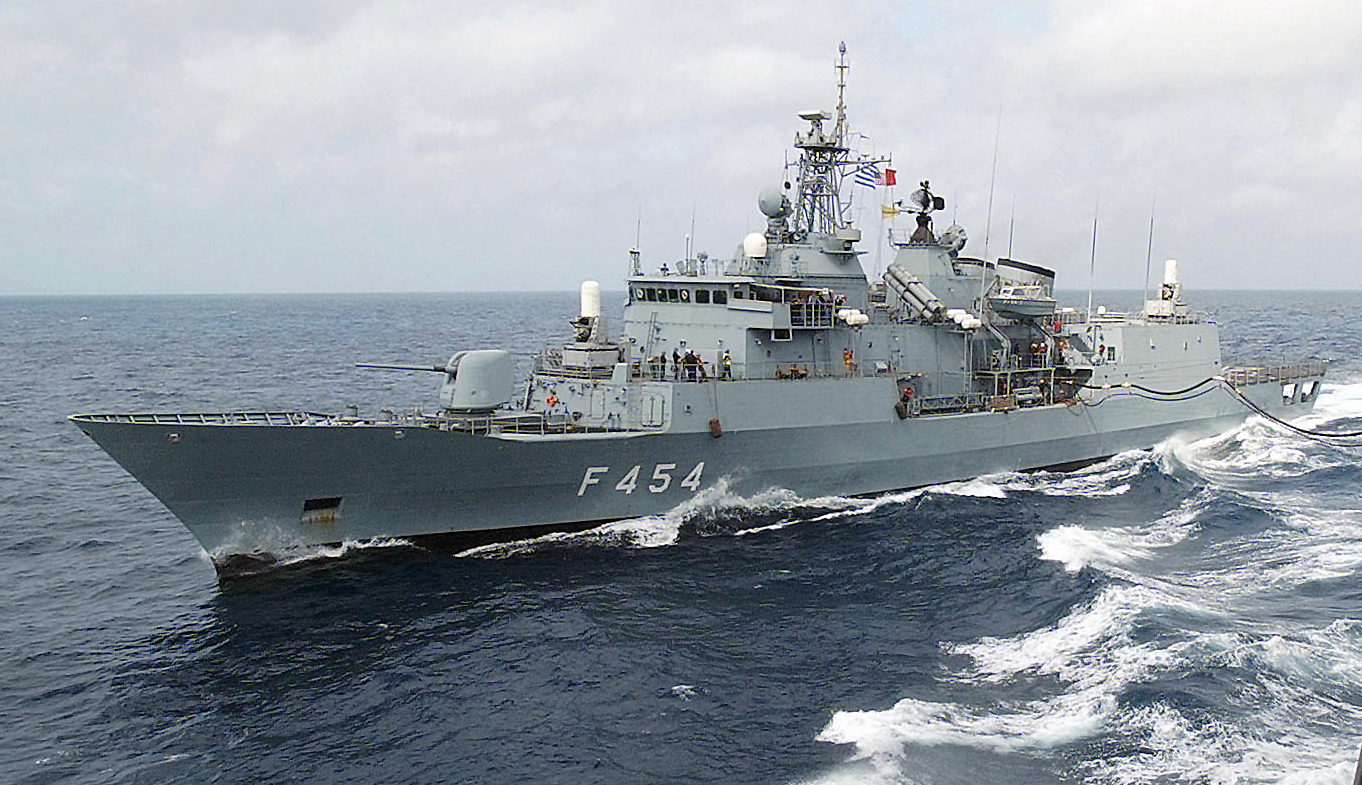
COMMAND. MARITIME POWER. INDUSTRIAL DEPTH.
EUROPEAN SECURITY. GREEK CONTRIBUTION.EUROPEAN MILITARY ANALYSIS / GREECE’S CONTRIBUTION / 28 OCTOBER 2026
Europe already operates military missions, commands multinational forces and finances industrial capacity. Its next challenge is to connect political authority, deployable forces and sustainable production. Greece is helping to build that capability at sea, at headquarters and on the Union’s southeastern frontier.
The strategic judgment: integration creates usable power.
Our assessment: the most useful route toward a stronger common European military capability starts with the functions Europe already performs together. Protecting shipping, running a multinational headquarters, generating trained contingents and organising industrial supply are tangible activities. They develop routines, interfaces and responsibility that political declarations alone cannot create.
Greece’s contribution belongs at the centre of that account. A country often discussed as a purchaser or a frontier state also supplies command infrastructure, naval experience and industrial capabilities. The Greek role in ASPIDES connects European trade protection to an operational headquarters in Larissa and national contributions at sea. Border security places Greece at the intersection of national sovereignty, European law, civilian agencies and military support.
A stronger European military capacity would give these contributions greater continuity. Its credibility would depend on forces that can be generated and sustained, common standards that work under pressure and an industrial base able to repair, replenish and adapt. These are practical tests of integration.
There is a distinction between this editorial argument and the present institutional position. The EU has no standing army. It draws on national assets for Common Security and Defense Policy operations. A common European military remains a political project; existing operations are evidence of collective action, not proof that a unified force already exists.
Council: security and defense ↗
What Europe already has—and how it works.
The existing architecture combines political decisions, military advice, planning structures and forces supplied by participating states. The Council sets operation mandates. Command arrangements translate those mandates into military tasks. Governments provide personnel and equipment, while national decisions and obligations continue to matter.
| Layer | Existing function | What it does not establish |
|---|---|---|
| CSDP operations | Military activity under an agreed EU mandate. | A permanently unified European armed force. |
| EU Rapid Deployment Capacity | A flexible framework of up to 5,000 troops, declared operational in May 2025. | A permanently deployed 5,000-person EU army. |
| MPCC | EU military planning and conduct structure; preferred headquarters for the Rapid Deployment Capacity. | Automatic authority over every national or European deployment. |
| National forces | Personnel, ships, aircraft, equipment and specialist capabilities. | Unlimited availability for simultaneous commitments. |
| Industrial and financial instruments | Support for research, production, procurement and common operation costs. | Command authority or operational readiness by themselves. |
The EEAS described the Rapid Deployment Capacity as operational on 20 May 2025. It can combine modified battlegroups with additional land, air, maritime, space and cyber capabilities. Deployment requires unanimous agreement among member states. The distinction between a standing force and a framework for generating a force is therefore essential.
For Greece, command specialists, communications, transport, medical support and sustainment can be as consequential as the headline contingent. Their contribution helps turn a political decision into an executable mission. Participation also creates experience in multinational planning and coordination that can be retained within national institutions.
EEAS, 20 May 2025: Rapid Deployment Capacity ↗
A portfolio of European missions, with different purposes.
Europe’s military activity is geographically and functionally varied. Maritime protection, embargo enforcement, stabilisation and training answer different needs. Their mandates should be read separately rather than combined into a single undifferentiated European force.
| Operation or mission | Core role | Greek strategic exposure |
|---|---|---|
| ASPIDES | Defensive maritime security and protection of shipping in the Red Sea crisis. | Command role, maritime trade, naval availability and support. |
| IRINI | Implementation of the UN arms embargo on Libya. | Central and eastern Mediterranean security and the Libya policy environment. |
| ATALANTA | Counter-piracy and protection of vulnerable shipping in the western Indian Ocean. | Sea-lane security and the broader maritime economy. |
| EUFOR ALTHEA | Security and stabilisation in Bosnia and Herzegovina. | Balkan stability and regional security. |
| EUMAM Ukraine | Military assistance and training for Ukraine. | European force-generation, training and industrial demands. |
The industrial consequences also differ. Maritime operations draw heavily on ship maintenance, sensors, communications and replenishment. Training missions place different demands on instructors, equipment availability and training infrastructure. A European capability assessment should follow the actual task and the resources it consumes.
EEAS, 15 July 2026: missions and operations ↗
ASPIDES: a European public good with a Greek command centre.
On 23 February 2026 the Council extended ASPIDES until 28 February 2027. It set a financial reference amount of nearly €15 million for common costs during 1 March 2026–28 February 2027. The operation is headquartered in Larissa and is led by Rear Admiral Vasileios Gryparis in that Council announcement.
ASPIDES has a defensive maritime-security mandate. Its tasks concern maritime awareness, accompanying vessels and protecting shipping against attacks at sea. The operation connects European political decisions to the protection of commercial routes whose disruption reaches ports, industry and consumers.
The nearly €15 million figure must be understood in its stated scope: common costs. It is not the complete cost of every ship, crew, maintenance period, weapon or nationally funded contribution. Confusing the two would understate what sustained maritime protection requires.
Our analysis: this makes ASPIDES a practical demonstration of European collective security. The benefits of protecting a trade route are distributed widely, while the immediate burden falls on the states providing headquarters, ships, people and support. A stronger common capability would need to make that distribution politically and financially durable.
It also illustrates why maritime endurance is an industrial issue. Ships require repair, crews need rotation, sensors and communications need support, and equipment must be replenished. The operational mandate becomes credible through a continuing chain of national and multinational contributions.
Council, 23 February 2026: ASPIDES mandate ↗
Greece contributes command, ships and operational learning.
The Greek headquarters role is more than a flag on an organisation chart. A multinational operation needs planning, coordination, information management and the ability to maintain a shared operational process across national contributions. Hosting that work anchors European military activity within Greek institutions.
Greek naval participation is documented in the MOD record. On 6 July 2024, Defense Minister Nikos Dendias and EU High Representative Josep Borrell visited the frigate Psara during its ASPIDES deployment. Dendias connected the mission to access to European ports and the economic effects of disruption to navigation.
Command at headquarters and command at sea are separate responsibilities. A Hellenic Navy announcement published on 16 March 2026 records the 14 March handover of force command from Greek Commodore Grigorios Nousias to Italian Rear Admiral Milos Argenton. That rotation is an example of multinational execution, rather than a change in the nationality of the operation’s headquarters.
Domestic technology adds another dimension. In a MOD-published interview on 2 February 2025, Dendias said the HAI-produced Centaur counter-drone system had been successfully tested in ASPIDES and discussed further development and production. That is an attributed official account of testing and programme intent; it is not an independently verified performance assessment.
Our analysis: the important industrial connection is the feedback loop between a deployed requirement and domestic engineering. Operational experience can inform system changes, training, integration and support. The value becomes durable when that knowledge is retained and translated into repeatable production and service capacity.
Greek MOD, 6 July 2024: Psara and European maritime security ↗
Hellenic Navy, 16 March 2026: force-command handover ↗
Greek MOD, 2 February 2025: Centaur and ASPIDES ↗
Greece’s frontier is a European responsibility with several legal roles.
The southeastern frontier brings together defense of national territory, civilian border management, maritime safety, search and rescue, asylum obligations and action against trafficking. These functions interact, but have different authorities and rules. A useful European-security account makes those distinctions visible.
Greek armed forces carry national defense responsibilities. Border management is supported by the Hellenic Police, Hellenic Coast Guard and European cooperation, including Frontex. NATO’s Aegean activity has its own allied framework. None of these institutions is interchangeable with the others.
The Danish MOD’s published 2025 contribution description illustrates how European cooperation works in practice: it lists a patrol-boat contribution to Joint Operation Poseidon in Greece in cooperation with Danish police, alongside other surveillance and personnel contributions. This is a dated example of multinational support, not a current force list.
NATO’s Aegean assistance framework dates to a February 2016 decision requested by Germany, Greece and Türkiye. Its published role is surveillance and information sharing in support of the relevant national authorities and Frontex. This allied activity should not be labelled an EU military operation.
Greece’s contribution to European security is therefore both geographic and institutional. It sustains national responsibilities at an external frontier while working through shared European and allied arrangements. The policy question is how the costs, capabilities and accountability of that responsibility are shared.
Legality is part of capability. Search-and-rescue obligations, access to asylum, non-refoulement and effective oversight affect legitimacy, cooperation and operational continuity. FRA’s April 2026 visit to Frontex operational areas in Greece examined activities and consulted national and agency personnel. A credible European-security feature includes those obligations alongside equipment and surveillance.
Danish MOD: Frontex contributions, 2025 reference ↗
NATO: Aegean assistance, updated 17 January 2023 ↗
FRA, 30 April 2026: visit to operations in Greece ↗
Measure the force that can be sustained.
A common European military capability is best assessed through usable output. Platform numbers and spending describe resources, but they do not show how long a mission can be sustained or which commitments can be met simultaneously.
For Greece, a ship assigned to a European mission also sits within a national fleet that has maintenance, training and other obligations. A headquarters requires skilled personnel and resilient communications. A new system requires integration and support. The European contribution becomes stronger when these commitments are planned as part of a complete readiness model.
Our proposed assessment follows five questions: what task has been agreed; which capabilities are committed; how quickly they can be generated; how they are supported; and how performance feeds back into training and industry. This framework can be applied to ASPIDES, a rapid-deployment package or another multinational operation without inventing an aggregate combat-readiness score.
Exercises are useful evidence of coordination, but they are not identical to sustained deployment. A declared capacity is a framework; a contribution is a commitment; an accepted and supported capability is an operational resource. Keeping those stages separate makes progress visible without overstating it.
A European force needs European industrial depth.
Military integration and industrial integration reinforce one another when requirements, standards and production are connected. Common procurement can improve scale and continuity; shared support arrangements can reduce fragmentation; interoperable systems can make multinational forces easier to sustain. Those outcomes depend on implementation.
EU instruments serve different parts of this chain. SAFE provides loans for eligible defense investment and common procurement. The European Defense Fund supports collaborative research and development. The European Defense Industry Programme supports industrial readiness, while the European Peace Facility has a separate role in military assistance and common operation costs.
For Greece, participation should be understood through the work retained: design, software, electronics, sensors, materials, manufacturing, integration, repair and support. A European customer base can give Greek companies a market beyond the timing and scale of national procurement. International programmes can also create dependencies on components, intellectual property and other partners.
Our assessment is that the strongest Greek industrial position combines specialist products with production and service infrastructure. Night vision, communications, counter-drone technology, unmanned systems, shipbuilding, heavy fabrication and maintenance are different contributions to the same wider capability chain. Individual awards and work packages must still be followed company by company.
Industrial sovereignty is also a matter of time. The relevant question is whether a critical item can be repaired, replaced or increased when demand changes. A product’s European origin alone does not establish spare capacity, access to technical data or an assured supply chain.
Council: European Peace Facility ↗
Toward a common European military: make the choices explicit.
Editorial position: stronger common European military capacity is a worthwhile objective when it creates reliable collective action and complements national defense. Its case is strongest when expressed as practical capabilities, accountable decisions and shared responsibility.
A deeper common force would require political agreement on missions and risk. It would need a clear chain of command, rules for national contributions, sustainable financing and democratic oversight. It would also need a workable relationship with NATO, whose members and responsibilities do not coincide exactly with the EU’s.
The treaty framework provides a route toward common defense through a unanimous European Council decision, with the treaty’s national constitutional requirements remaining relevant. Mutual assistance obligations are another part of that framework. Neither should be treated as automatic authorisation for a particular deployment or as evidence that all political questions have been resolved.
There are competing approaches. One emphasises stronger EU institutions and common assets; another prioritises national forces working through coalitions and NATO. A practical integration agenda can be judged by whether it improves force generation, support and decision-making across those arrangements.
For Greece, the opportunity is to shape the common capability from an existing contribution: maritime command, national forces, frontier responsibilities, logistics and industry. The corresponding priority is reciprocity—European security arrangements should make the burden of protecting shared interests more durable and more evenly supported.
ASPIDES offers a concrete starting point. It is already a collective operation with a defined purpose, a Greek headquarters role and multinational execution. The next institutional steps can be evaluated against what makes such an operation more sustainable, more capable and more accountable.
EEAS, 24 September 2025: development of common security and defense policy ↗
What to watch next: an evidence-based integration ledger.
| Indicator | Evidence of substantive progress | Greek relevance |
|---|---|---|
| Political authority | Adopted mandates, agreed decision procedures and clear responsibilities. | Predictability of commitments and support. |
| Force generation | Named contributions, exercises and documented readiness milestones. | Planning national and multinational obligations together. |
| Common support | Funded maintenance, logistics and replenishment arrangements. | Fleet endurance and industrial work. |
| Interoperability | Accepted interfaces, communications and tested procedures. | Greek participation across multinational formations. |
| Industrial output | Signed work packages, accepted deliveries and repeat production. | Engineering and manufacturing retained in Greece. |
| Accountability | Transparent mandates, oversight and credible investigation mechanisms. | Legitimacy and continuity of cooperation. |
This ledger separates announcements from delivered institutional and industrial change. It provides a continuing editorial agenda for a European military analysis desk, with Greece treated as a contributor to common security and an industrial participant in its development.
Source register and scope.
Reviewed 28 October 2026. Publication and event dates are retained in the text where available. Official sources establish mandates, announcements and attributed statements; operational effectiveness claims remain attributed. This feature contains no live unit tracking, tactical coverage assessment or classified readiness estimate.
- Council: security and defense ↗
- EEAS, 20 May 2025: Rapid Deployment Capacity ↗
- Council, 23 February 2026: ASPIDES mandate ↗
- EEAS, 15 July 2026: missions and operations ↗
- Greek MOD, 6 July 2024: Psara and European maritime security ↗
- Greek MOD, 2 February 2025: Centaur and ASPIDES ↗
- Hellenic Navy, 16 March 2026: force-command handover ↗
- Danish MOD: Frontex contributions, 2025 reference ↗
- FRA, 30 April 2026: visit to operations in Greece ↗
- NATO: Aegean assistance, updated 17 January 2023 ↗
- Council: European Peace Facility ↗
- EEAS, 24 September 2025: development of common security and defense policy ↗
Dated examples distinguish past contributions from current commitments. Mission mandates, common costs, national contributions and equipment performance are separate evidence categories. No aggregate fleet availability or current personnel total is inferred from these examples.