PUBLISHED 27 October 2026
Lykomitros Steel: a Greek industrial asset for global industry

DEFENSE INDUSTRY GR / THE ANALYSIS
Greek Industrial CapabilityTHE SYSTEM EXPLAINED
Lykomitros: where fabrication could enter defense
Potential work categories must remain separate from awarded military programmes.
MATERIAL + TRACEABILITY
Documented material grades, certificates and batch control.
FABRICATION
Welding, machining and dimensional control against customer drawings.
INSPECTION
Qualified examination, records and customer acceptance.
SUPPLY-CHAIN ENTRY
A specific package, responsible prime and commercial qualification.
Conceptual explainer. Connections describe functions, not undisclosed operational interfaces.
The credible industrial route
A steel-fabrication business can be relevant to naval infrastructure, platforms, production facilities or support equipment without designing a complete weapon. Each route has different material, quality, security and customer-approval requirements. Construction experience is evidence of execution in its own category; it is not a substitute for qualification to a particular defense standard.
The most useful next step is a narrowly defined supplier proposition: name the package, the customer requirement, the production process and the evidence needed for acceptance. The alternative is a broad defense narrative that outruns the company’s approved scope. No named Achilles, FDI or submarine award is inferred from capability alone.
Supplier ecosystem ↗ · Shipyard work-package reference ↗
THE ASSET COMPANY
A Greek industrial asset.
Working across global markets.
Lykomitros Steel brings together heavy fabrication, complex welded structures, mechanical assemblies and international project execution. Its industrial base in Volos connects Greek engineering and production to customers in offshore wind, oil and gas, power generation, infrastructure and defense. This is a manufacturing business whose relevance extends across markets and national procurement cycles.
The company’s value lies in the combination of physical assets and accumulated execution knowledge. Large fabrication halls and yards provide the working envelope. Forming, welding, machining, coating and handling equipment turn that space into a production system. Engineering, project management and quality control connect individual operations to a complete customer package. Experience with international contractors adds familiarity with multi-company projects, demanding interfaces and cross-border delivery.
For Greece, that combination is strategically useful. It represents productive capacity that can serve foreign capital programmes, retain industrial skills locally and contribute to demanding defense supply chains. For international customers, it is a manufacturing resource with an established portfolio across several technically complex industries.
Our assessment is that Lykomitros should be understood through this breadth: a Greek industrial asset with international reach, an existing defense offering and manufacturing capabilities that carry value well beyond any single programme.
THE PRODUCTION SYSTEM
What the factory
can make possible.
The supplied 2026 company portfolio reports 500,000 m² of uncovered area and 60,000 m² of covered space. Its foundation-product table lists outer diameters up to 12 m, wall thickness of 230 mm, maximum XXL-monopile weight of 3,000 tonnes and steel grades up to S690. Together, these parameters describe the scale of the company’s declared heavy-fabrication offering.
The operating scope extends from heavy-plate procurement to primary and secondary steel fabrication, coating, ancillary-equipment assembly, commissioning, certification, transport and load-out. These stages link material processing to a complete industrial delivery. The combination is relevant wherever a large structure must arrive as part of a coordinated engineering and installation programme.
ENGINEERING & EXECUTION
The equipment matters.
The sequence matters more.
The corporate fabrication overview describes CNC cutting, drilling, slotting, bevelling, punching and blast preparation, alongside automated welding and ConstruSteel production traceability. Its published equipment list includes 20 submerged-arc welding machines, DAVI plate rollers rated at 155 mm × 3,000 mm and 202 mm × 4,200 mm, and PEMA flange-fitting equipment. The older equipment page and the 2026 product envelope describe different layers of the manufacturing offer; their dates and scope are retained in the source notes.
These processes have different roles. Rolling creates the shell geometry. Fit-up positions shells and flanges for assembly. Welding joins the structure while dimensional control follows the geometry through production. Machining prepares critical interfaces. Blasting and coating prepare the finished surface for its operating environment. Production planning coordinates those operations across the available bays and handling equipment.
The 2026 portfolio also describes in-house modular trailers of 2,000-tonne capacity and heavy-lift trolleys of 1,000-tonne capacity. Handling and load-out are part of the industrial offer: large assemblies need a coordinated route between the production area, yard, transport equipment and port interface. Volos connects the manufacturing base to maritime delivery for international projects.
INTERNATIONAL REFERENCES
Follow the work.
See the global capability.
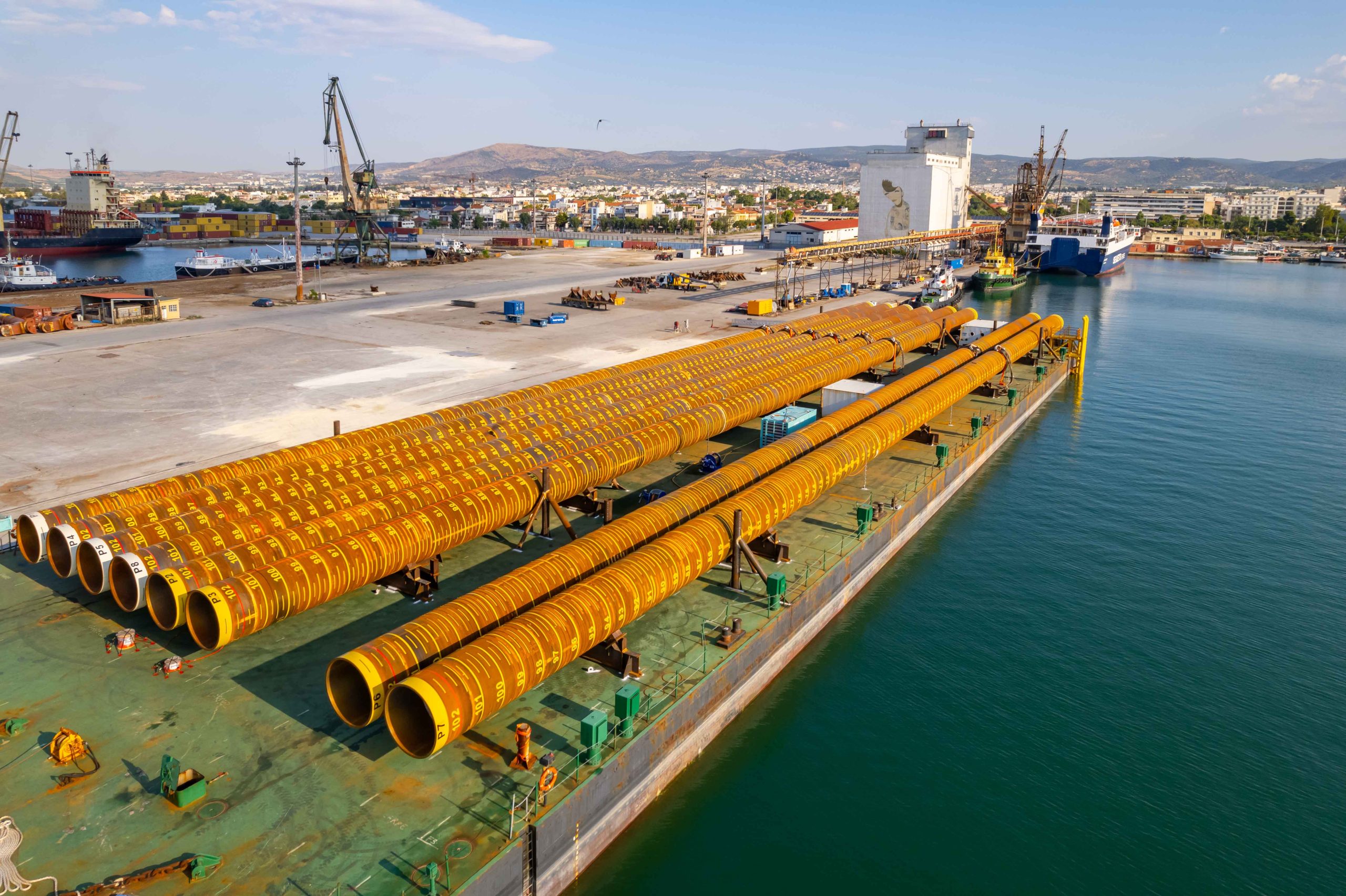
The international portfolio spans offshore foundations, floating-wind structures, secondary systems and oil-and-gas equipment. The following company-reported references show both geographic reach and the range of manufacturing responsibility. The detailed project sections that follow explain what each adds to the industrial picture.
| Project / customer as reported | Published work package | Industrial significance |
|---|---|---|
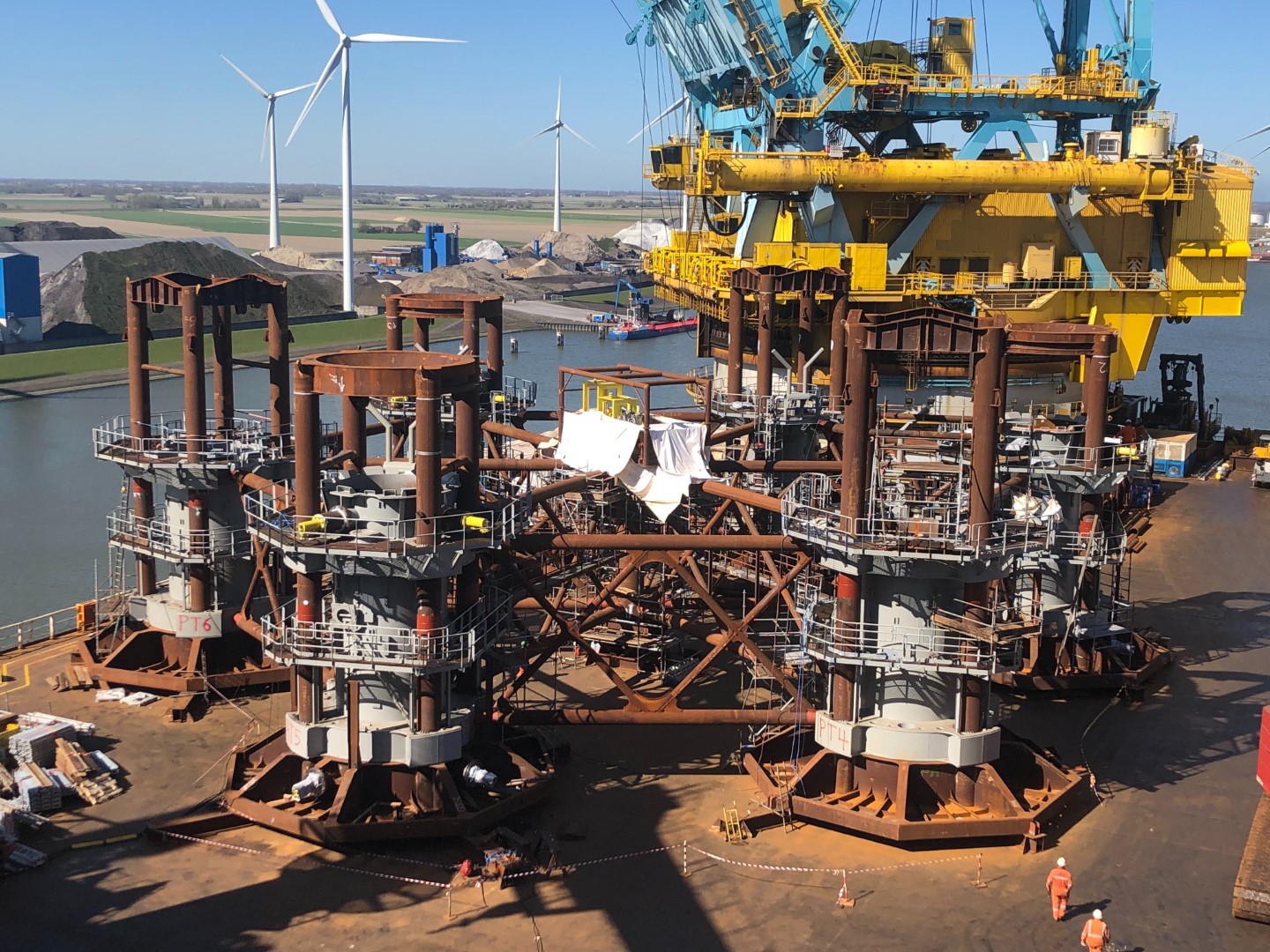
| Neart na Gaoithe, UK / Saipem | Pin piles, casings and six subsea-template towers; secondary steel, machining and hydraulic pre-integration. | Foundation manufacture plus assembly and equipment interfaces. |
| Courseulles-sur-Mer, France / Saipem | 64 offshore-wind casing foundations; portfolio lists 10 m outer diameter. | Repeated large-diameter fabrication for an international project. |
| EFGL, France / Smulders–Ocean Wind | Trusses, braces and TKY joints for floating wind. | Complex structural connections and assembly geometry. |
| Archer Wind / Ocergy design | Pilot bolted floater fabrication during 2024–2025. | Manufacturing to an external design and coordination with project partners. |
| THOR, Denmark | Secondary structures, electrical outfitting, ICCP and commissioning. | Structures connected to installed equipment and functional handover. |
| Bentec / oil and gas | Masts, substructures, mud-tank systems and factory mock-ups. | Mechanical, hydraulic and electrical integration before deployment. |
| Inch Cape / Seaway 7 | 2026 portfolio lists a 46 m × 46 m pile-installation-frame template, 1,200 tonnes. | Large installation tooling. Acceptance and delivery status need separate confirmation. |
Engineering, fabrication, installation and end-project ownership are distinct roles within these chains. The portfolio identifies TWD engineering for THOR installation-tool towers and Ocergy design for the Archer Wind pilot floater. Those relationships show Lykomitros manufacturing within international teams whose participants bring different technical responsibilities.
QUALITY & QUALIFICATION
Engineering discipline
across demanding applications.
Lykomitros’s 2026 portfolio lists ISO 9001:2015, EN 1090-1-2, ISO 3834-2, ISO 45001:2018, ISO 14001:2015 and AQAP 2110:2016. These references cover quality management, structural execution, welding, occupational safety, environmental management and defense quality requirements. The documentary status of the AQAP process is set out in the evidence register below.
The manufacturing significance is the ability to connect material identification, production records, welding, dimensional control and inspection to a defined assembly. Across offshore structures, industrial equipment and defense work, those disciplines make complex packages manageable over a long production sequence.
Traceability is particularly valuable when many apparently similar components belong to different positions or assemblies. It connects the material and process history to the finished item. For structures that combine primary steel, access systems, machined connections and installed equipment, configuration control also connects fabrication to subsequent installation and maintenance.
Quality is therefore part of the productive asset. It sits within the production process alongside equipment, engineering and skilled labour, supporting repeatable work and continuity between orders.
DEFENSE INDUSTRIAL CAPABILITY
Defense is part of
the industrial portfolio.
Lykomitros’s defense capabilities sit alongside its international energy, offshore and infrastructure business. Its corporate material identifies military equipment, logistics, hangars and special structures for military vehicles. SEKPY, the Hellenic Manufacturers of Defense Materiel Association, lists it within ground-vehicle, machinery, materials and structures, and naval-platform supply categories. The association profile describes metal structures, equipment foundations and specialised construction subsystems.
This places the company within an essential part of defense manufacturing: the structures and assemblies that connect platforms, equipment and infrastructure. A complete defense system draws on far more than the headline platform. Its industrial base includes fabricated structures, support equipment, specialised assemblies, production tooling and facilities that enable integration, operation and maintenance.
Lykomitros’s wider industrial record adds depth to that defense offering. Offshore work brings experience in large, geometrically demanding structures and marine delivery chains. Oil-and-gas packages combine fabrication with mechanical and electrical integration. Infrastructure work adds engineering, transport and installation responsibility. These are distinct markets, connected by a substantial manufacturing base.
The international dimension is central. Foreign shipyards, OEMs, EPC contractors and system integrators are part of the addressable industrial landscape. Greek defense procurement is one source of demand within that landscape. The company’s broader position is that of a Greek manufacturer able to participate in international industrial programmes.
The strategic issue for Greece is the scale and sophistication of the work retained domestically: engineering responsibility, complex assembly, production knowledge and long-term customer relationships. Lykomitros’s existing capabilities make it a substantive example of that industrial opportunity.
THE COMMERCIAL PROPOSITION
Manufacturing breadth.
International project experience.
Engineering, fabrication, assembly and delivery are connected parts of the industrial offer. The international portfolio brings those capabilities into projects across offshore energy, infrastructure, industrial systems and defense.
Engineering, fabrication, assembly and delivery are connected parts of the industrial offer. The international portfolio brings those capabilities into projects across offshore energy, infrastructure, industrial systems and defense.
THE INTERNATIONAL BUYER’S BRIEF
The commercial asset:
scope, integration and delivery.
Lykomitros’s portfolio spans different levels of responsibility. Some projects centre on fabrication. Others include engineering, secondary structures, installed systems, factory assembly, transport and site installation. This range allows the business to work at several points in an international supply chain, from a defined structural package to a more integrated industrial assembly.
| Industrial role | Value within the project |
|---|---|
| Engineering and detailing | Connect the functional requirement to buildable geometry, production documentation and installation interfaces. |
| Heavy fabrication | Form, weld and assemble large or technically demanding structures. |
| Integration | Combine primary and secondary steel with mechanical, hydraulic or electrical elements within the agreed scope. |
| Factory assembly | Bring components together before transport, coordinating fit-up and installation sequence. |
| Delivery and installation | Manage the transition from manufacturing site to transport, load-out and the next project stage. |
For global customers, combining several of these roles can reduce the number of industrial interfaces to be managed separately. For the manufacturer, it creates a larger technical and commercial scope. The company’s reference work shows why that scope matters: a mud-tank farm, offshore installation tool and architectural assembly each combine different production and delivery requirements.
Serial work and project work also complement one another. Repeated foundation components reward production planning and consistent execution; bespoke assemblies draw on engineering flexibility and interface management. A company active in both can develop a wider body of manufacturing knowledge than a single-product description suggests.
Our assessment is that this range is a major part of the asset proposition. It gives international customers several ways to work with the business and connects Greek manufacturing to different investment cycles and end markets.
THE GREEK INDUSTRIAL DIMENSION
Greek capability.
International industrial value.
The economic contribution of a company such as Lykomitros extends beyond the value of its steel output. Engineering, planning, machining, welding, assembly, surface treatment, inspection, transport and installation create a chain of industrial activity. The more of that chain is performed in Greece, the wider the domestic capability retained around each project.
International work connects this capability to demand beyond the size and timing of the Greek market. Offshore-wind foundations, drilling equipment, industrial plants and infrastructure are financed through different programmes and customer groups. That diversity can support the continuity of skills and production knowledge, while also creating opportunities for suppliers, technical services and logistics providers around the manufacturer.
For defense, the significance is an industrial base that exists across several markets. The same national ecosystem includes specialist platform companies, electronics and software businesses, materials suppliers, heavy manufacturers and engineering services. Their contributions differ; the strategic strength lies in the range and depth of those capabilities.
Lykomitros is an asset within that ecosystem because it combines manufacturing scale with technically varied project experience. Its international portfolio makes the case tangible: Greek facilities and personnel are connected to offshore energy projects, industrial systems and infrastructure in several countries.
The useful measures are the work performed, the technical responsibility carried, the engineering retained, the skills sustained and the continuity of international business. These describe industrial substance. They also provide a stronger basis for understanding Greece’s position in global defense and industrial supply chains.
OFFSHORE FOUNDATIONS
Large structures.
Several manufacturing disciplines.
The Neart na Gaoithe references connect Lykomitros to the offshore-wind construction chain in Scotland. Its portfolio identifies Saipem as the customer for pin piles, casing foundations and subsea drilling-template towers. The pin-pile section lists 168 items and a maximum length of 80 m. A separate casing-foundation section lists 168 foundations, with fabrication, coating, transportation and loading support through the Port of Volos.
The six drilling-template towers add a different layer of complexity. Their scope includes fabrication and coating, secondary steel such as platforms, railings and gratings, machining of ancillary components and hydraulic-system pre-integration. This is a combination of structural production and preparation for a larger offshore assembly.
Courseulles-sur-Mer in France provides another foundation reference. The portfolio identifies 64 casing foundations, 10 m outer diameter and Saipem France as the customer. The manufacturing significance is the repeated production of large geometries within a coordinated construction programme.
A further monopile reference names Van Oord and lists 600 tonnes per monopile and a maximum length of 80 m, with load-out in September 2023 and installation in November 2023. These project particulars show how production, handling and installation form successive stages of the same international delivery chain.
FLOATING WIND & OUTFITTING
Manufacturing within
new offshore architectures.
The Archer Wind reference identifies Lykomitros’s fabrication of the pilot bolted floater during 2024–2025, with Ocergy responsible for the design. The industrial role is particularly relevant because floating wind brings together structural modules, connection concepts, assembly sequencing and transport. It creates a manufacturing task that extends beyond a simple cylindrical foundation.
The EFGL reference in France identifies trusses, braces and TKY joints for an offshore floating project, with Smulders–Ocean Wind named in the customer field. The portfolio lists 36 pieces across three sets and a maximum length of 90 m. The value of this work lies in complex structural geometry and the connections between members, as well as overall size.
THOR in the Danish North Sea adds outfitting and functional scope. The portfolio describes supply, electrical outfitting and commissioning of secondary structures for monopiles, including external access systems, internal cassettes, impressed-current cathodic protection and boat landings. A related section identifies installation-tool towers and engineering by TWD.
These references show several levels of participation within offshore wind: primary structures, complex floating-system members, installation tooling and outfitted secondary systems. Each draws on a different combination of forming, welding, assembly, equipment integration and project coordination. Together they broaden the company’s industrial position within the sector.
The 2026 portfolio also lists a pile-installation-frame template for Seaway 7’s Inch Cape project, with dimensions of 46 m × 46 m and a stated weight of 1,200 tonnes. Another reference identifies 120 m pin piles for Saipem’s Neptun offshore project. These are portfolio references; the evidence register distinguishes them from separately confirmed handover dates.
OIL, GAS & INTEGRATED EQUIPMENT
From steel fabrication
to working industrial assemblies.
The Bentec references show Lykomitros operating across masts, substructures and mud-tank farms. One Azerbaijan reference for SOCAR AQS identifies a 150-tonne mast system, with fabrication, special transport and mock-up installation at the company’s facilities. The factory assembly stage connects fabrication to the preparation of a larger operating system.
A separate Bentec reference covers 20 sets of mud-tank farms, totalling 8,000 tonnes in the portfolio, for projects associated with Algeria, the Czech Republic, Europe and Poland. Individual onshore-platform tanks are listed at 70–90 m³. The scope combines fabrication, special transportation and fully workable factory mock-ups.
The Ukraine reference identifies five mud-tank-farm sets, including housing, with mechanical and electrical equipment. The engineering significance of these packages is the coordination of vessel and frame structures with installed equipment and service interfaces. The finished package is an assembly of several functional elements.
Halliburton appears in a separate reference for ten units of 340 BBL Baraswift storage tanks. The portfolio assigns design, fabrication and factory mock-up to Lykomitros. SOCAR AQS is also named for 400 waste skips and mud-cutting boxes, with design, fabrication and transport, and DNV GL 2.7-1 certification indicated for that product scope.
This portfolio gives the business several forms of industrial experience: large structures, repeat equipment sets, integrated tanks and transportable offshore units. Its commercial breadth comes from serving different points in the energy supply chain, including the contractors and equipment providers that organise complete projects.
INFRASTRUCTURE & PRECISION
Heavy engineering
and detailed production.
The infrastructure portfolio demonstrates a second kind of range: the combination of very large structural work with detailed, component-intensive production. For the Domokos railway bridge, the company identifies a 10,000-tonne package for the AKTOR–TERNA–J&P joint venture, covering engineering, fabrication, transport and installation. The bridge is described as a high-speed railway structure with cable-suspended arches and main spans in the 130–160 m range.
The Ikonio railway-bridge reference for ELEMKA lists 1,700 tonnes and a 120 m main span, again combining engineering, fabrication, transport and installation. The Kamares reference for VINCI Construction Grands Projets lists a 1,000-tonne double-span bridge and an engineering-and-design, fabrication and installation scope.
Architectural work brings a different production problem. The Les Halles reference in Paris, for Seele, lists 180,000 different pieces of secondary steel for galvanised and painted roofing. The industrial content here is component identification, dimensional consistency, finishing and coordination within a large assembly, rather than tonnage alone.
Other Seele references include the Tottenham Court Road station entrance upgrade, Brook Green, Victoria Gate in Leeds and a steel façade for glass in Edinburgh. The company also lists façade work in Berlin for GIG Fassaden. These references connect Greek fabrication to complex architectural projects with demanding interfaces between steel, glazing and site installation.
Our assessment is that the breadth is significant. Heavy structures develop handling and large-geometry experience; component-intensive work develops detailed production coordination. Both contribute to a manufacturing organisation’s ability to manage complex assemblies across different end markets.
INDUSTRIAL PLANTS & SPECIALISED PACKAGES
A wider base
of engineering demand.
Power generation, waste treatment, mining and industrial infrastructure add further dimensions to the portfolio. For the Datteln power project in Germany, the company lists 5,500 tonnes of bridges, towers and belt conveyors, with EON as owner and TAIM WESER as contractor. The stated scope includes design, fabrication and transport.
References associated with ELEMKA and the METKA group include power-plant buildings, pipe racks and supporting structures for Deir Ali in Syria and Hassi R’Mel in Algeria, with 3,000 tonnes listed for each project. A Greek power-station reference covers 800 tonnes of boiler-structure upgrades and specialist pulverised-fuel ducts.
Waste-treatment references show a broader systems scope. Ferrybridge 2 in the UK, for Hitachi Zosen Inova, is listed as a 900-tonne steel-structure package with static calculations, design and fabrication. The Epirus anaerobic-digestion project includes two Kompogas steel digesters and a package spanning shafts, housings, sealing units, gearboxes, bearings, valves, insulation, piping and electrical cabling.
The Skouries reference for Hellas Gold lists 7,000 tonnes across buildings, platforms, pipe racks and workshop structures, with design, engineering, fabrication, transport and installation. The Olympias Phase II reference covers chutes, tanks, pump boxes and ductwork, including rubber lining.
Other specialised references include Jet A1 fuel tanks in Malta, mooring buoys for Energean in Kavala and silo-conveyor structures at Vassiliko in Cyprus. These projects show how a common engineering and fabrication base can serve different materials-handling, storage, energy and infrastructure requirements.
The business implication is a broad set of customer relationships and technical applications. The company participates in markets whose investment cycles differ, while retaining a substantial common core of engineering, fabrication, integration and delivery capability in Greece.
SOURCES / REVIEWED 28 OCTOBER 2026
Evidence and attribution.
Project quantities, product parameters, handling capacities, customer names and work scopes above are attributed to the supplied Lykomitros Steel — Company Introduction Full 2026. They describe the company’s reported portfolio and declared capabilities. Product-envelope parameters and production-rate figures are not treated as audited output, current utilisation or independently confirmed delivery status.
- Lykomitros corporate activity statement: defense, energy, infrastructure and industrial scope.
- Corporate fabrication overview: process and equipment descriptions; undated.
- Corporate facilities overview: older figures of 130,000 m² uncovered and 43,000 m² covered differ from the 2026 portfolio. They are retained as separate source vintages.
- SEKPY profile: defense-industry categories, equipment foundations and specialised structural subsystems.
- Company AQAP announcement: reports Stage 1 audit completion and Stage 2 scheduled for 2026. The portfolio lists AQAP 2110:2016; final current certification status has not been independently established.
The public material reviewed does not disclose individual defense-contract particulars. This limits contract-level reporting and is not evidence that the company lacks defense contracts or experience. No specific weapons-programme workshare is assigned without a named source.
Project photographs are existing Lykomitros Steel corporate assets. Infographics distinguish company-reported particulars from Defense Industry GR analysis. Exact current certificate scopes, actual annual output and the handover status of the latest portfolio references remain matters for documentary confirmation.
Editorial disclosure: independently prepared from the named company and industry sources. No interview, sponsorship, endorsement or company approval is asserted.


