
ARCHITECTURE / CONCEPTUAL RELATIONSHIPS
How the layers connect
Functional relationships, not a disclosed interface or deployment diagram. The three missile families retain their own fire-control and support requirements. The separate counter-UAS box does not assert an unverified connection to the accepted Greek national network.
THE SYSTEM EXPLAINED
Achilles Shield: a network of defensive layers
Named programme families are shown below. Their presence in an announcement does not establish delivery or operational acceptance.
SENSORS / ELTA MMR
Radar observations feed tracking and identification. Detection is different from authorisation to engage.
NATIONAL C2 / RAFAEL LEAD
A common picture, national decisions and coordination between compatible defensive elements.
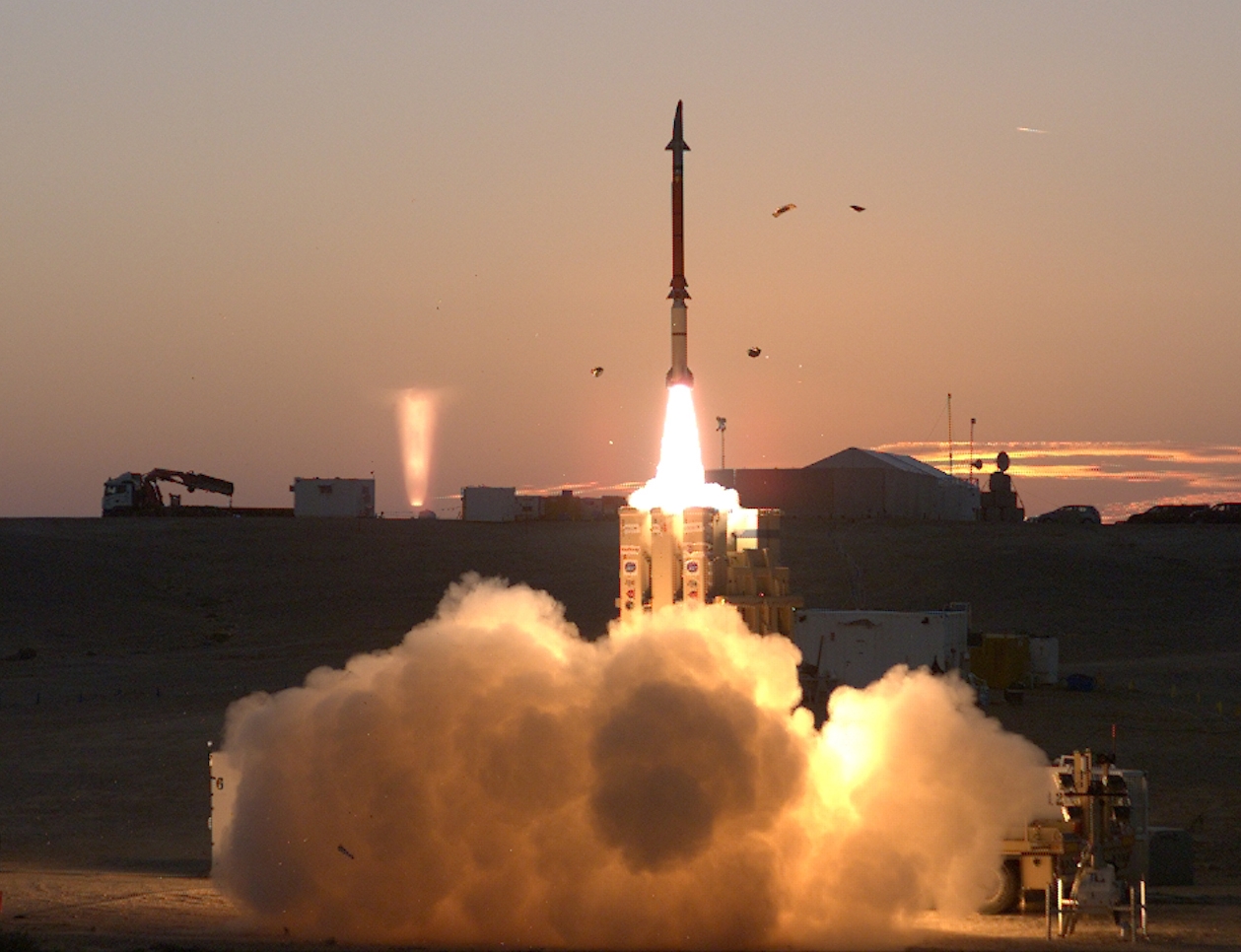
DAVID’S SLING / STUNNER
Hit-to-kill air and missile defense; a distinct interceptor and support chain.
BARAK MX / IAI
Modular interceptor family: published MR 35km, LR 70km, ER 150km. Greek missile mix undisclosed.
SPYDER / RAFAEL
Quick-reaction layer. PYTHON-5 and I-Derby options depend on the contracted variant.
DRONE DOME / SEPARATE DEAL
Counter-UAS sensors, C2 and electronic effects. The €26m agreement is distinct from the main package.
Programme scope: Israeli MOD, 31 August 2026. Product roles: IAI, Rafael and RTX. Conceptual architecture; no deployment coverage or undisclosed wiring is represented.
What integration has already demonstrated
HAI reported a BARAK MX–Kentavros field demonstration on 2 February 2026, including threat assessment, cueing and electronic countermeasures under common C2. This establishes an attributed technical milestone, not acceptance of the complete national architecture. It also gives the Greek integration story a concrete starting point: test evidence and configuration control, rather than an assumption that every subsystem remains unconnected. HAI demonstration statement ↗
DEFENSE INDUSTRY GR / THE ANALYSIS
Achilles Shield: Architecture, Integration & Industry
TECHNICAL DOSSIER / UPDATED 28 OCTOBER 2026
Achilles Shield: the systems, their roles and the upgrade path
Achilles Shield is an integrated national air-defense programme, not a single missile. Its value comes from connecting detection, identification, national decision-making and several defensive layers. This reference separates the signed Greek programme from the wider capabilities advertised for each product family.
Confirmed scope ↓ · System reference ↓ · Architecture ↓ · Extensibility ↓ · Support & industry ↓ · Evidence gaps ↓
What is confirmed for Greece
Israel’s MOD announcement of 31 August 2026 names David’s Sling, BARAK MX, SPYDER, ELTA MMR radars and a new Rafael-led national command-and-control system. It separately records a €26m Drone Dome agreement. Those named elements are confirmed announced scope; quantities, missile mixes, detailed interfaces and acceptance results are not disclosed in that release. Israeli MOD: original Hebrew announcement ↗
Greece’s MOD gives a €3.035bn programme budget and describes expected participation by 19 Greek companies. The announcement does not identify their work packages. Its references to “above 25%” and €750m need a consistent denominator before a precise domestic share can be calculated. This is planned participation, not Greek revenue already earned. Greek MOD: agreement and industrial participation ↗
System reference
| Element | Role | What the Greek record establishes |
|---|---|---|
| David’s Sling / Stunner | Air and missile defense, including a terminal ballistic-missile-defense role. | Named in Israel’s signed-programme announcement; no Greek battery or interceptor count disclosed. |
| BARAK MX | Networked air and missile defense using a family of interceptors. | Product family named; the Greek missile mix and accepted configuration remain unspecified. |
| SPYDER | Quick-reaction air defense; specific performance depends on variant and missile. | Family named; do not equate this automatically with the All-in-One configuration. |
| ELTA MMR | Multi-mission radar and air-defense sensing. | MMR family named; exact radar configuration and quantity need programme documentation. |
| National C2 | Combines the national picture and coordinates air-defense decisions. | Rafael identified as development lead; software rights and complete interfaces not disclosed. |
| DRONE DOME | Counter-UAS sensing, identification, C2 and selected effects. | Separate €26m agreement announced; Greek sensor/effector package not itemised. |
David’s Sling: why the interceptor mechanism matters
RTX describes Stunner as a two-stage, multi-pulse, hit-to-kill interceptor: it destroys through direct impact rather than a conventional explosive warhead. The manufacturer lists tactical ballistic missiles, rockets, aircraft, drones and cruise missiles among the system’s threat classes. It identifies Rafael and RTX as development partners and RTX production of firing units. These are product descriptions, not a guarantee of Greek performance against every threat. RTX: David’s Sling and Stunner ↗
Our assessment: the important distinction is between an aircraft-defense purchase and a system intended to contribute against missile threats as well. A single headline range cannot describe all target trajectories and engagement conditions. We therefore do not draw national coverage circles or give an unsupported probability of interception.
Israel’s MOD reported a further test series on 11 February 2026, incorporating lessons and new capabilities. It identifies ELTA’s radar and an Elbit-developed command centre within the Israeli David’s Sling system. This subsystem is distinct from the Rafael-led Greek national C2; the two should not be confused. Israeli MOD: upgrade test and subsystem roles ↗
BARAK MX: the interceptor family and network
IAI presents BARAK MX as modular, network-centric architecture able to combine sensors, battle management and fire units, including land/naval connections. Its current product page lists these advertised interceptor ranges:
| Interceptor | Manufacturer’s published range | Propulsion description |
|---|---|---|
| BARAK SR | 15km | Family option; no Greek order inferred. |
| BARAK MR | 35km | Single-pulse motor. |
| BARAK LR | 70km | Dual-pulse motor. |
| BARAK ER | 150km | Dual-pulse motor with booster. |
These are product-family figures, not defended radii or confirmation that Greece has ordered every interceptor. IAI describes active-RF seekers and common components. The useful extensibility is the ability to add units and compatible sensors within a managed architecture. IAI: BARAK MX family and architecture ↗
Our assessment: selecting a mix of interceptors changes training, storage, replenishment and life-cycle obligations. Common family components may simplify some support, but they do not remove the need to fund the actual missile inventory and its maintenance.
SPYDER: read the variant before quoting a range
Rafael’s All-in-One brochure describes a single 8×8 vehicle combining radar, electro-optics, command functions and up to eight canisterised missiles. It can operate independently or connect to higher-level C2. Published AiO figures are shown below as a specific product example, not Greece’s verified configuration.
| AiO missile option | Published maximum missile range | Published maximum intercept altitude |
|---|---|---|
| PYTHON-5 SR | 15km | 6km |
| I-Derby SR | 20km | 9km |
| I-Derby ER | 40km | 12km |
Rafael also lists four simultaneous target engagements / controlled missiles for this configuration. Performance values depend on the configuration and conditions; missile range and intercept altitude are different measures. Rafael: SPYDER All-in-One specification ↗
Our assessment: an integrated vehicle can reduce the footprint of a local defensive element. A distributed network can offer different integration and support choices. The purchase should be evaluated against the selected Greek variant, not a composite of the strongest specifications from several SPYDER versions.
MMR: the radar is a configurable family
IAI describes the ELM-2084/MMR family as mobile AESA radars supporting air defense and weapon-location missions, remote operation and networked use. The manufacturer lists scalable configurations and integration with additional sensing such as identification, electro-optical and signals-intelligence inputs. Family descriptions include different sizes and operating modes. IAI: MMR capabilities and configuration ↗
Our assessment: radar detection range is not missile engagement range. Nor does detecting an object establish identification or authorisation to engage it. An air-defense system needs track quality, compatible data exchange and consistent identification through the command chain. Sensor integration is therefore a substantive engineering task.
Drone Dome: complementary counter-UAS scope
Rafael’s published brochure describes a modular combination of radar, electro-optics, passive RF sensors, C2 and jamming. It supports external information inputs and local or remote operation. Different configurations can be tailored to the customer. The Greek agreement does not establish which radar, RF sensor or effectors are included, and does not establish a laser purchase. Rafael: Drone Dome brochure ↗
Our assessment: counter-UAS is a distinct problem inside wider air defense. A detection, identification and response chain must be validated against defined targets and operating conditions. The existence of an electronic countermeasure does not mean it can stop every drone, and the existence of an optional effector in a product catalogue does not make it part of Greece’s package.
How the architecture becomes usable capability
Multiple sensors contribute observations.
Tracks and identification become a common picture.
National authority prioritises and authorises a response.
Compatible defensive elements receive usable instructions.
Results inform readiness, training and updates.
Conceptual explainer, not a disclosed wiring diagram. The programme needs more than a common screen: data formats, timing, identification, secure communications, human authority and tested interfaces must work together. Connection to existing Patriot, aircraft or naval systems is not established by a generic interoperability claim. A formal interface, testing and acceptance are separate milestones.
The national C2 layer is a central industrial and sovereignty question. Greece needs clarity over who can maintain interfaces, change software, introduce new sensors, validate updates and continue operating when a vendor support cycle changes. “Open architecture” describes a design approach; it does not itself grant source code, unrestricted IP or independent integration rights.
Extensibility: what can be added, and what it takes
| Growth route | Potential value | Required evidence / dependency |
|---|---|---|
| Additional sensors | A wider or more diverse picture. | Supported interfaces, identification rules, network capacity and acceptance. |
| Additional fire units or missile types | More defensive choices and inventory. | Funded award, approved configuration, trained staff and sustainment. |
| Software and threat-library updates | Adaptation without replacing the whole system. | Release authority, validation, support rights and an agreed update process. |
| Greek counter-UAS systems | Potential domestic engineering and shorter update cycles. | A specified integration contract and tested compatibility; Centaur is not automatically integrated. |
| Naval/air-domain information exchange | Potentially better joint awareness. | Actual data-sharing permissions, certified links and joint testing. |
| Future directed-energy equipment | A possible future defensive layer. | Separate selection, power/cooling provision, qualification and support; no Greek laser purchase established here. |
Our assessment: extensibility is valuable only if additions can be made at acceptable cost and without lengthy requalification. The strongest Greek position is an enduring national ability to specify, test, accept and support changes. A promise of future compatibility should become a contractual obligation with a responsible integrator.
Availability, replenishment and Greek industrial value
Interceptors, radar modules, power systems, electronic assemblies, software, test equipment and training all need continuing support. The useful question is annual availability and the time needed to restore or adapt capability. This dossier does not estimate stockpiles, current unit readiness or tactical vulnerabilities.
Greek industrial participation can range from infrastructure and assembly to electronics, integration, repair, software and design responsibilities. Those categories retain different levels of value. An assembly task with imported inputs is not equivalent to ownership of an interface or certified repair capability. Measure each package by technical authority, accepted output, recurring work and export rights.
The initial agreement can create a sizeable installed base, but recurring domestic value depends on the follow-on support arrangement. Supplier selection should be followed through qualification, tooling, documentation, training and first accepted delivery. A list of interested companies is not evidence of a production line.
Programme maturity and the evidence still needed
| Question | Current assessment | Next observable milestone |
|---|---|---|
| Signed or proposed? | Signed G2G programme announced 31 August 2026. | Subsystem awards and implementation records. |
| Which systems? | Named families are in the Israeli MOD release. | Greek variant, quantities and missile mix. |
| When operational? | ERT reports development by July 2029; treat this as a reported target. | Contractual schedule, deliveries, integration tests and formal acceptance. |
| How much Greek work? | Planned participation announced; exact package allocation unresolved. | Named contracts, certified roles and paid/delivered output. |
| What future upgrades? | Product families advertise modular development; Greek rights not fully disclosed. | Support, software and integration provisions. |
| How confident? | High on announced scope; conditional on performance and completion. | Independent test/acceptance evidence suitable to each claim. |
ERT: implementation reporting, 31 August 2026 ↗
Alternative explanation: an ambitious architecture may deliver useful individual systems before delivering the full network effect. That would still be progress, but it would be a different capability state from complete national integration. We will update the assessment when dated evidence changes the configuration or maturity.
Annual capability milestones ↗ · Greece–Israel programme inventory ↗ · Greek stakeholders ↗
Sources reviewed 28 October 2026. Product specifications are attributed manufacturer publications; they are not independent certification of the Greek installation. English summaries of Hebrew programme announcements are paraphrases.